
Reconsidering the to-do list
What if your to-do list was a menu, not marching orders? Or, how I learned to stop fighting my brain and embrace my PDA.

Advice abounds in the productivity-hacking world aimed at helping us mortals use to-do lists (among other tools) effectively. And it’s not just advice; a bevy of phone apps, websites, and (lest I forget) stationery stores selling gorgeous planners and tablets of paper will happily take your money in exchange for the promise of life management. My social media feeds fill up every January and August with people just like me, imagining a world where finding the perfect planner will somehow turn them into goddesses of organization, where never a task will fall out of memory. Ahhh. It’s a beautiful dream.
The reality, though, is that we are human, and there is no perfect planner or app or pad of paper that will somehow turn us into creatures who flawlessly do everything on schedule.
But what I’ve realized in the last year is that I seem to use to-do lists differently than my friends and colleagues do. At least, I think I do. (I don’t have access to the inner workings of others’ brains.)
Several months ago, I added to my running to-do list pad: “Write about to-do lists.” I knew I’d get to it … eventually. And that’s how my system works. Because…behold! You are now reading that piece. #Winning
How others use to-do lists. (I think.)
I did some Googling to unearth advice on how to use to-do lists effectively. NPR tells us that anything you can do in under two minutes must stay off your list; instead, you should just do it, like right now. Also, it’s a great idea if you can schedule a time to do the various things on your list. (This is sometimes called time blocking, and I’ve been made to believe that people who don’t do it truly aren’t serious about working efficiently. E.g., “If you don’t control your schedule, it will control you.” Blerg.)
The Stanford University Center for Teaching recommends making a list of literally everything you have to do in a week, then creating a daily to-do list each morning (or the night before) you can mark off as you go. They also suggest noting whether something is a cognitively demanding (or not) task so you can be more strategic about what you choose to do and when.
Robert Talbert, a math professor and prolific writer (see his and David Clark’s book, Grading for Growth, and their newsletter by the same name), has written extensively about the way the “getting things done” system has worked for him. I truly envy this systematizing of things…and I say envy, because I know I couldn’t do this consistently. I’d only be disappointed in myself if I tried.
One other notable advice-giver from my Googling was Kevin Kruse1 (beware—clicking that link is going to take you to some toxic productivity sales site, eww), who argues that you should “live in your calendar, not in your to-do list.”
Let me just say that a lot of this advice is probably good for many (most?) people. But very little of it works for me.
The obsession with productivity and efficiency
The relentless chase for the most efficient way to be productive is celebrated as an end unto itself in our late-stage capitalist society…but it’s worth pausing to ask ourselves why. Robert Chapman’s book, Empire of Normality: Neurodiversity and Capitalism, traces the history of disability (including neurodivergence) on a parallel track with the emergence of the industrial age.
Chapman’s argument is that only with the efficiency demanded of an industrial, capitalist society does disability become a threat. Indeed, his research demonstrates that pre-industrial revolution, those who were disabled were often thought to be touched by God and cared for by entire communities. Once worthiness became associated with production, though, the disabled became drains on the very communities that once cherished them. Our world in 2026 very much ascribes to that belief, sometimes implicitly and sometimes out loud.2
A good life is not defined by our output or our efficiency. While perspectives vary, ancient texts—and lots of evidence—suggest that a good life comes from the relationships we have with others, the way we are able to use our talents (whatever they may be) to serve our communities, and the expression of love and equanimity. I’ve written before about the yamas and niyamas in yogic philosophy; these are a set of principles I return to again and again to provide ballast to my life. They ground me.
Work may be rewarding, but it does not, it must not, define us.
Persistent drive for autonomy—the other PDA
My friend Cait introduced me to the concept of PDA, which some in the disability rights community call the pervasive drive for autonomy.3 (Read more here and here.)
As soon as she said those words, I knew they described me. I’d already figured out I was autistic, but this particular expression of autism resonates so strongly with me. Recognizing this about myself has helped me understand why most advice about to-do lists, like that above, simply doesn’t work for me.
For starters, I absolutely loathe being told what to do. Even by myself. It’s common for PDAers to resist biologically necessary things—you know, like eating or drinking or sleeping or even just going to the bathroom when we need to go, like, NOW. Why do I do this? I couldn’t really explain why I’ll sit here at my computer and continue typing even when my body is screaming, “THIS IS ABOUT TO GET MESSY, LIZ!” … but I will. Because nobody’s going to tell me what to do, kthx.
Thinking about a daily to-do list as a directive causes this resistant thinking to flare…again, even when I’m the one who wrote the list. Nobody’s going to force present-Liz to do anything, including recent-Liz or past-Liz (or future-Liz). Period.
My demand for autonomy is super strong. And that’s why I now think about my to-do list as a menu, not my marching orders.
It’s worth noting that autonomy isn’t just a thing for some autistics (and other neurodivergent folks). Self-determination theory (SDT) is a well-researched model that suggests three qualities lead to higher levels of motivation: autonomy, competence, and relatedness. While SDT suggests that everyone benefits from some degree of autonomy, PDA amplifies this good-to-have quality into something far more critical to motivation.
What shall I have today?
I find the cognitive offloading of the many, many details flitting about my (probably4) ADHD brain to be necessary. Seriously, I couldn’t accomplish anything ever if I didn’t have a way to put those thoughts somewhere while I focus.
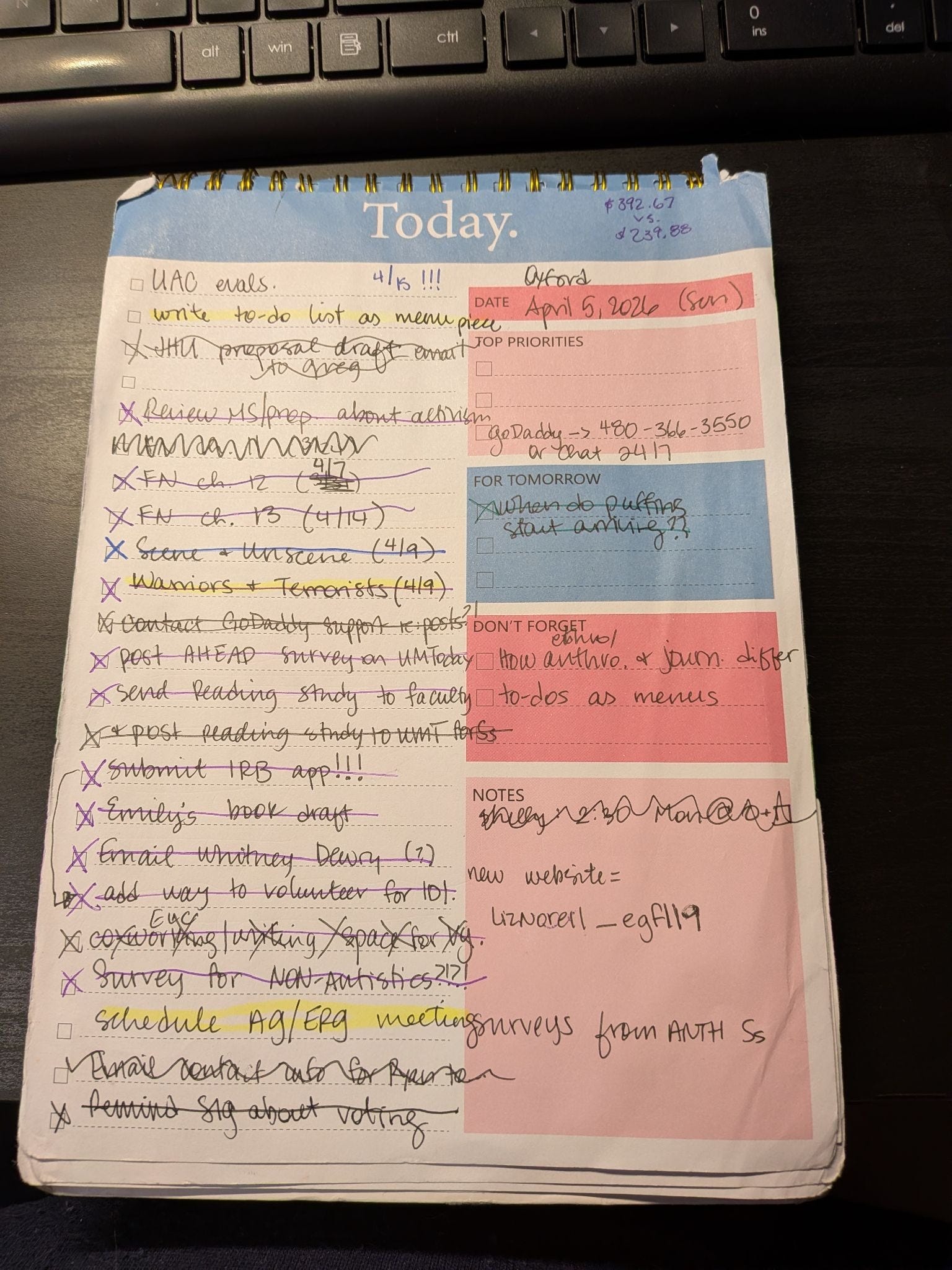
And so I have this brilliant to-do list pad of paper (you can buy one from the evil Bezos empire here, or better yet go find something like this at your indie bookshop or stationery store), where I do a mental download of everything that I think of that I want to do. I carry it with me most places. I’m about to finish a whole pad of these lists, and the structural integrity is…not great. I use binder clips to keep it together.
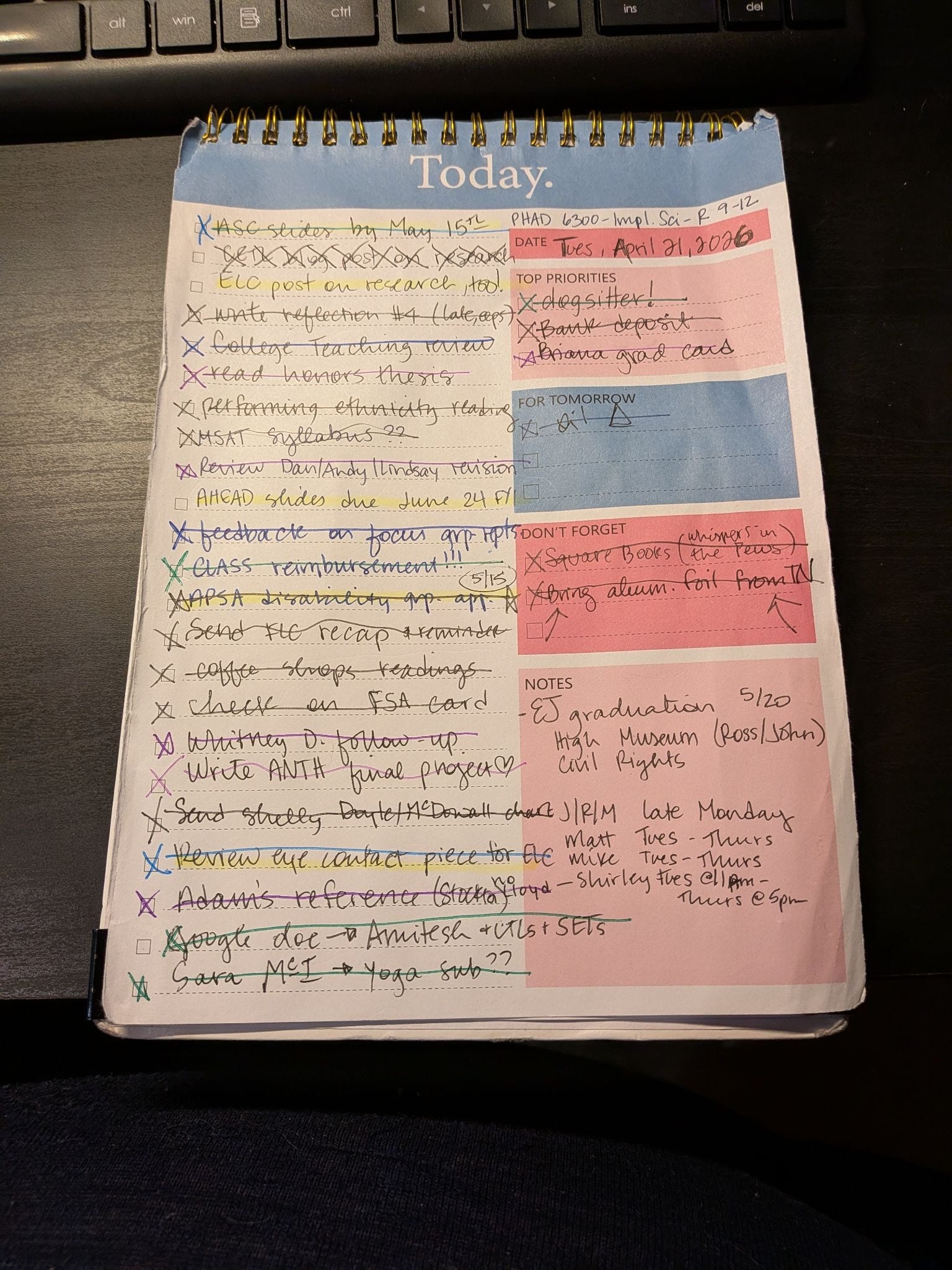
When I don’t have something urgent to do (which is rare, because did I mention the ADHD?!), I start flipping through the last 3-5 pages of my current list to see what looks appealing. I ask myself questions like: What matches my mood right now? What do I have the cognitive bandwidth for? What sounds interesting and fun? What will feel good crossing off my list right now?
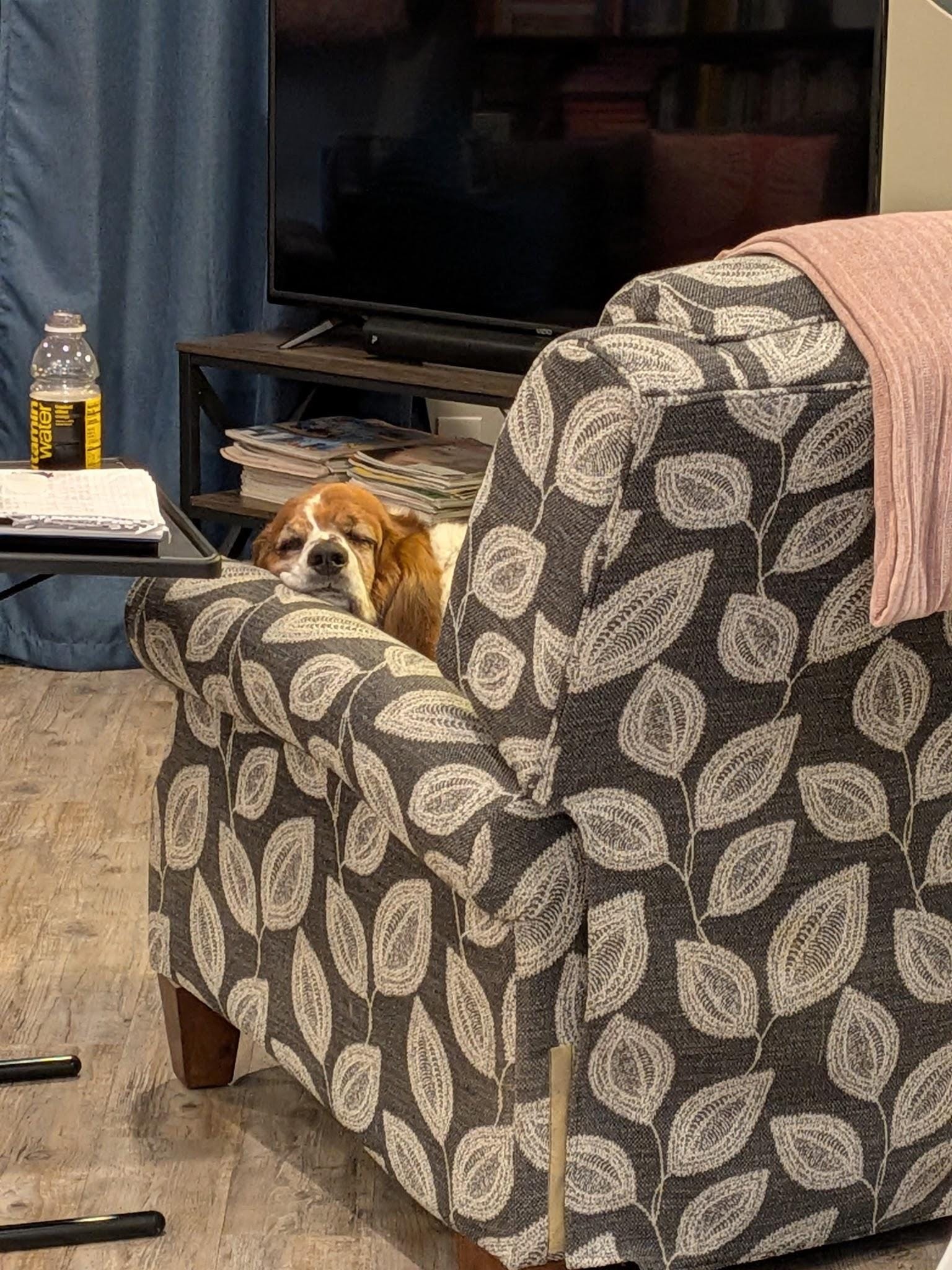
There are things on the list that literally require about 45-60 seconds of attention—usually emails that I’ve been procrastinating sending, for whatever (usually inarticulable and not-very-good) reason. There are things that will take even less time, but require me to make a phone call. (Ugh.) And then there are things that require me to have the promise of uninterrupted, uncluttered thinking time…such as writing this piece, which I’ve been doing for an hour, after dark, while in an empty house and while my sassy basset hound, Ginger, is snoring.5
This system works for me. It follows almost none of the rules promoted by the productivity hacking gurus community. It also creates almost no shame or self-loathing, because I’ve come to see this as a manifestation of the messy, creative, and (yes) highly productive brain I’m proud to have grown.
You do you, boo.
I often tell my students this:
Until roughly around the penultimate year of my PhD program, I was such a Judgy McJudgerson about my own procrastination. I never started research projects or papers early; I wrote nearly every paper—through an undergraduate degree and four, yes four, master’s programs—within 48 hours of its due date. I knew this was Not How Good Students Operate, so I thought of myself as someone who was impersonating a decent student in class but who was secretly mediocre at best.
And then, as I was finishing up my dissertation in one of about a half-dozen weekends6, probably tucked in a coffee shop or library carrel and assaulting my keyboard with my lightning-fast typing, I realized:
I have accomplished every academic goal I’ve ever set for myself.
Did they look pretty? Probably not. Did I ever make missteps? Of course. But did it ever cost me a goal? Nope.
So maybe I wasn’t an imposter after all. Maybe this was just how I do my work. And maybe that could be ok.
When I had this realization, I stopped beating myself up for my just-in-time work habits. I stopped calling it procrastination.
One size rarely fits all
I often remark that I tend to write (and teach) the things I need to read (and learn), and this piece is no different—I needed someone to tell me that it was okay to find my own systems a long, long time ago. I have spent the majority of my adult years trying to fit into the advice freely dispensed by this efficiency-industrial complex. If there’s an app, a planner, or a productivity tool that others laud, I’ve probably tried to use it…and failed.
If we widen the aperture, I’ve failed at lots of other things people insist are The Right Way to work and/or live. A partial list: I loathe citation managers; I simply will not ever make myself write for ___ minutes a day/week; budgets and I are mortal enemies; my email inbox(es) will never contain zero messages; my work spaces will always be cluttered (as will basically all of my living spaces); diets don’t work; I need a TV on to fall asleep; and on, and on, and on.
I tell my students: You are not a bad person if you don’t work well ahead of your deadlines. Just because something works for others doesn’t mean it will work for you. It’s worth experimenting, but ultimately, I encourage students to ask themselves whether their work habits are serving their goals. Are they taking reasonably good care of themselves (i.e., not constantly pulling overnighters then driving, because that is extremely dangerous). If they need to make changes, I encourage experimenting with other ways of working.
But in the end, the only good system is the one that you can actually stick with, and it doesn’t matter whether it works for other people—only you.
This Kevin Kruse is decidedly not the historian Kevin M. Kruse, whose advice I generally find worthy of consideration. His website is much, much better and will not make you feel like you immediately need a cleansing shower. His Bluesky account is a terrific follow, too.
I won’t link to or quote it, but there was a moment early in the Trump 2.0 presidency when the Secretary of Health and Human Services suggested that autistics were living tragic lives because they’d never know the thrill of having a job and would never pay taxes. Tragic…?
Historically, PDA has been called “pathological demand avoidance,” but the disability communication has reframed it in more neutral terms to move away from the medical model’s tendency to turn every difference into a pathology. No thanks.
I haven’t been formally diagnosed as an ADHDer, but I’m getting tested soon.
This is the only context in which I get any truly serious work done: nighttime/dark, nobody conscious nearby, ideally with some mid-1990s music playing.
I wrote my master’s thesis (around 200 pages) in three fitful weekends. Similarly, I did indeed write the bulk of my dissertation in about a half-dozen weekends, separated by MONTHS of reading, thinking, and making almost no visible progress on The Writing. A daily writing habit has never (and likely will never) be part of my repertoire.
This is generally how I operate, along with not knowing which version of me will be present from day to day (motivated me or don’t talk to me me). My daughter has PDA and is AuDHD. Keep researching and talking about it—it really needs to be taken more seriously in the US.
I love this piece! This is how I operated in grad school. I had a little notebook that I carried everywhere. Then, when I graduated and started my career, I tried to do more formal task management systems and even read much of Talbert's writings about the Getting Things Done framework. They all have failed, so I recently went back to my little notebook. Thinking about it as a menu, I think will help even more, though, because I do feel like I have still been thinking prescriptively about it.